23 min to read
Python Methods Explained: Instance, Class, and Static Methods - A Complete Guide
Understanding the three types of methods in Python classes for cleaner and more efficient code
Overview
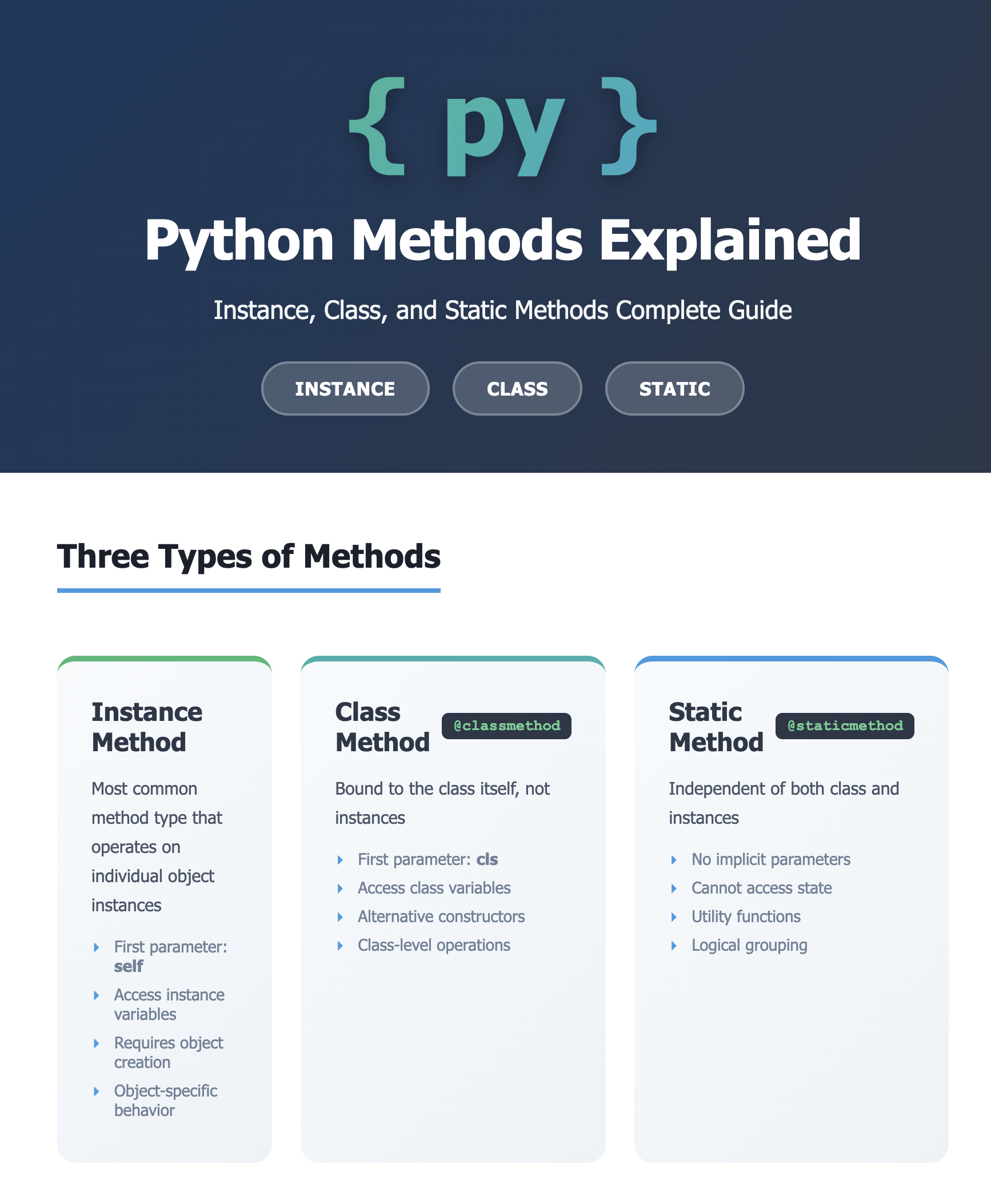
Python classes support three distinct types of methods: instance methods, class methods, and static methods. Understanding the differences between these method types is crucial for writing clean, efficient, and maintainable object-oriented code.
Each method type serves a specific purpose and has unique characteristics that make it suitable for different scenarios. By mastering these three method types, developers can create more organized and intuitive class structures that follow best practices in object-oriented programming.
1. Instance Method
Instance methods are the most common type of method in Python classes. They operate on individual instances (objects) of a class and have access to the instance’s attributes and other methods.
Basic Example
class Student:
    def __init__(self, name, grade):
        self.name = name
        self.grade = grade

    def introduce(self):  # Instance method
        return f"Hello, I'm {self.name} and I'm in grade {self.grade}."

# Usage
student = Student("John", 3)
print(student.introduce())  # Hello, I'm John and I'm in grade 3.
Key Characteristics
Self Parameter:
- The first parameter is always
self, which refers to the instance calling the method - Provides access to instance attributes and other instance methods
Instance Access:
- Can access and modify instance attributes (e.g.,
self.name,self.grade) - Can call other instance methods
- Requires an object to be created before use
Typical Usage:
- When you need to access or modify instance-specific data
- For operations that depend on the state of individual objects
When to Use Instance Methods
Instance methods should be used when:
- You need to work with object-specific data (
self.name,self.grade, etc.) - The method’s behavior depends on the instance’s state
- You’re implementing core functionality that defines what the object can do
2. Class Method
Class methods are bound to the class itself rather than individual instances. They are defined using the @classmethod decorator and receive the class as their first parameter.
Basic Example
class Student:
    student_count = 0  # Class variable

    def __init__(self, name, grade):
        self.name = name
        self.grade = grade
        Student.student_count += 1

    @classmethod
    def get_student_count(cls):  # Class method
        return f"Total students: {cls.student_count}"

    @classmethod
    def from_string(cls, student_str):  # Alternative constructor
        name, grade = student_str.split('-')
        return cls(name, int(grade))

# Usage
student1 = Student("John", 3)
student2 = Student("Jane", 2)
print(Student.get_student_count())  # Total students: 2

# Creating object using alternative constructor
student3 = Student.from_string("Mike-1")
print(student3.name)  # Mike
Key Characteristics
Class Parameter:
- The first parameter is
cls, which refers to the class itself - Cannot access instance-specific attributes
Class Variable Access:
- Can access and modify class variables
- Can be called without creating an instance
Calling Convention:
- Called through the class:
ClassName.method() - Can also be called through instances, but this is not recommended
When to Use Class Methods
Class methods are ideal for:
Working with Class Variables:
- Managing data shared across all instances
- Tracking aggregate information (like counting instances)
Alternative Constructors (Factory Methods):
- Creating instances from different data formats
- Implementing multiple ways to initialize objects
Class-Level Operations:
- Functionality that relates to the class as a whole
- Operations that don’t require instance-specific data
3. Static Method
Static methods are independent of both the class and its instances. They are defined using the @staticmethod decorator and don’t receive an implicit first parameter.
Basic Example
class MathUtils:
    @staticmethod
    def add(x, y):
        return x + y

    @staticmethod
    def is_adult(age):
        return age >= 18

    @staticmethod
    def validate_email(email):
        return '@' in email and '.' in email

# Usage
print(MathUtils.add(5, 3))  # 8
print(MathUtils.is_adult(20))  # True
print(MathUtils.validate_email("test@email.com"))  # True

# Can also be called through an instance (but not recommended)
util = MathUtils()
print(util.add(10, 20))  # 30
Key Characteristics
No Implicit Parameters:
- Does not receive
selforclsas the first parameter - Cannot access instance or class variables
Independence:
- Operates independently of class/instance state
- Functions like a regular function but is namespaced within a class
Calling Convention:
- Called through the class:
ClassName.method() - Can be called through instances, but this defeats the purpose
When to Use Static Methods
Static methods are appropriate when:
No State Required:
- The function doesn’t need access to class or instance data
- The logic is self-contained and independent
Utility Functions:
- Grouping related utility functions within a class
- Organizing helper functions logically
Logical Association:
- The function conceptually belongs to the class
- Improves code organization and readability
Comparison Summary
| Feature | Instance Method | Class Method | Static Method |
|---|---|---|---|
| Decorator | None | @classmethod |
@staticmethod |
| First Parameter | self |
cls |
None |
| Instance Variable Access | ✓ Possible | ✗ Not Possible | ✗ Not Possible |
| Class Variable Access | ✓ Possible | ✓ Possible | ✗ Not Possible |
| Calling Method | instance.method() |
Class.method() |
Class.method() |
Practical Example: Date Class
Here’s a comprehensive example that demonstrates all three method types working together in a real-world scenario.
from datetime import datetime

class Date:
    def __init__(self, year, month, day):
        self.year = year
        self.month = month
        self.day = day

    # Instance Method: Uses object data
    def format(self):
        return f"{self.year}-{self.month:02d}-{self.day:02d}"

    def add_days(self, days):
        """Instance method that modifies the object"""
        # Simplified implementation
        self.day += days
        return self

    # Class Methods: Alternative constructors
    @classmethod
    def today(cls):
        """Create a Date instance for today"""
        now = datetime.now()
        return cls(now.year, now.month, now.day)

    @classmethod
    def from_string(cls, date_string):
        """Create a Date instance from a string"""
        year, month, day = map(int, date_string.split('-'))
        return cls(year, month, day)

    @classmethod
    def from_timestamp(cls, timestamp):
        """Create a Date instance from a Unix timestamp"""
        dt = datetime.fromtimestamp(timestamp)
        return cls(dt.year, dt.month, dt.day)

    # Static Methods: Independent utility functions
    @staticmethod
    def is_leap_year(year):
        """Check if a year is a leap year"""
        return year % 4 == 0 and (year % 100 != 0 or year % 400 == 0)

    @staticmethod
    def validate_date(year, month, day):
        """Validate if a date is valid"""
        if month < 1 or month > 12:
            return False
        if day < 1 or day > 31:
            return False
        return True

    @staticmethod
    def days_in_month(year, month):
        """Return the number of days in a month"""
        if month in [1, 3, 5, 7, 8, 10, 12]:
            return 31
        elif month in [4, 6, 9, 11]:
            return 30
        else:
            return 29 if Date.is_leap_year(year) else 28

# Usage Examples
# Instance Method: Working with object data
date1 = Date(2026, 4, 14)
print(date1.format())  # 2026-04-14

# Class Methods: Alternative constructors
date2 = Date.today()  # Create from today's date
date3 = Date.from_string("2026-12-25")  # Create from string
date4 = Date.from_timestamp(1734567890)  # Create from timestamp

# Static Methods: Utility functions
print(Date.is_leap_year(2024))  # True
print(Date.validate_date(2026, 2, 30))  # False
print(Date.days_in_month(2024, 2))  # 29
Analysis of the Example
Instance Methods (format, add_days):
- Work with the object’s state (
self.year,self.month,self.day) - Provide functionality specific to individual date instances
Class Methods (today, from_string, from_timestamp):
- Provide alternative ways to create Date instances
- Act as factory methods for flexible object creation
- Return instances of the class
Static Methods (is_leap_year, validate_date, days_in_month):
- Perform date-related calculations without needing instance or class data
- Provide utility functions logically grouped with the Date class
- Can be used without creating a Date instance
Best Practices and Design Patterns
Factory Method Pattern with Class Methods
Class methods are perfect for implementing the Factory Method pattern:
class DatabaseConnection:
    def __init__(self, host, port, database):
        self.host = host
        self.port = port
        self.database = database

    @classmethod
    def from_config_file(cls, filepath):
        """Create connection from configuration file"""
        config = load_config(filepath)
        return cls(config['host'], config['port'], config['database'])

    @classmethod
    def from_environment(cls):
        """Create connection from environment variables"""
        return cls(
            os.getenv('DB_HOST'),
            int(os.getenv('DB_PORT')),
            os.getenv('DB_NAME')
        )

    @classmethod
    def development(cls):
        """Create connection with development defaults"""
        return cls('localhost', 5432, 'dev_db')

    @classmethod
    def production(cls):
        """Create connection with production defaults"""
        return cls('prod.example.com', 5432, 'prod_db')
Organizing Utility Functions with Static Methods
class StringUtils:
    @staticmethod
    def is_palindrome(text):
        """Check if text is a palindrome"""
        clean = ''.join(c.lower() for c in text if c.isalnum())
        return clean == clean[::-1]

    @staticmethod
    def truncate(text, length, suffix='...'):
        """Truncate text to specified length"""
        if len(text) <= length:
            return text
        return text[:length - len(suffix)] + suffix

    @staticmethod
    def count_words(text):
        """Count words in text"""
        return len(text.split())

    @staticmethod
    def capitalize_words(text):
        """Capitalize first letter of each word"""
        return ' '.join(word.capitalize() for word in text.split())

# Usage
print(StringUtils.is_palindrome("A man a plan a canal Panama"))  # True
print(StringUtils.truncate("This is a long text", 10))  # This is...
Tracking Instance Count with Class Methods
class Resource:
    _instance_count = 0
    _instances = []

    def __init__(self, name):
        self.name = name
        Resource._instance_count += 1
        Resource._instances.append(self)

    @classmethod
    def get_instance_count(cls):
        """Get total number of instances created"""
        return cls._instance_count

    @classmethod
    def get_all_instances(cls):
        """Get all active instances"""
        return cls._instances.copy()

    @classmethod
    def reset_count(cls):
        """Reset instance counter"""
        cls._instance_count = 0
        cls._instances.clear()

# Usage
r1 = Resource("Resource1")
r2 = Resource("Resource2")
print(Resource.get_instance_count())  # 2
print(len(Resource.get_all_instances()))  # 2
Common Pitfalls and How to Avoid Them
Pitfall 1: Using Static Methods When Class Methods Are Needed
Wrong:
class User:
    active_users = 0

    @staticmethod
    def increment_users():
        # Error: Can't access class variable
        User.active_users += 1  # Hard-coded class name
Correct:
class User:
    active_users = 0

    @classmethod
    def increment_users(cls):
        cls.active_users += 1  # Works with inheritance
Pitfall 2: Trying to Access Instance Data in Class Methods
Wrong:
class Product:
    def __init__(self, name, price):
        self.name = name
        self.price = price

    @classmethod
    def apply_discount(cls, discount):
        # Error: Can't access self.price
        return self.price * (1 - discount)
Correct:
class Product:
    def __init__(self, name, price):
        self.name = name
        self.price = price

    def apply_discount(self, discount):
        # Instance method can access instance data
        return self.price * (1 - discount)
Pitfall 3: Overusing Static Methods
Consider:
class MathOperations:
    @staticmethod
    def add(x, y):
        return x + y

    @staticmethod
    def subtract(x, y):
        return x - y
Better Alternative:
# If functions don't need to be in a class, use a module
def add(x, y):
    return x + y

def subtract(x, y):
    return x - y
Decision Tree: Choosing the Right Method Type
Does the method need to access instance data (self.attribute)?
├─ YES → Use Instance Method
└─ NO → Does it need to access class data or create instances?
    ├─ YES → Use Class Method
    └─ NO → Does it logically belong to the class?
        ├─ YES → Use Static Method
        └─ NO → Consider module-level function
Quick Reference Guide
Use Instance Methods When:
- Accessing or modifying instance attributes
- The behavior depends on the object’s state
- Implementing core object functionality
Use Class Methods When:
- Creating alternative constructors
- Working with class variables
- Functionality applies to the class as a whole
- Need to maintain inheritance compatibility
Use Static Methods When:
- The function is related to the class conceptually
- No access to instance or class data is needed
- Grouping utility functions for organization
- The function could be a regular function but belongs to the class namespace
Advanced Example: Cache with All Three Method Types
from functools import wraps
from time import time

class Cache:
    _global_cache = {}
    _cache_hits = 0
    _cache_misses = 0

    def __init__(self, ttl=3600):
        self.ttl = ttl
        self.instance_cache = {}

    # Instance Method: Works with instance-specific cache
    def get(self, key):
        """Get value from instance cache"""
        if key in self.instance_cache:
            value, timestamp = self.instance_cache[key]
            if time() - timestamp < self.ttl:
                Cache._cache_hits += 1
                return value
        Cache._cache_misses += 1
        return None

    def set(self, key, value):
        """Set value in instance cache"""
        self.instance_cache[key] = (value, time())

    # Class Methods: Manage global cache
    @classmethod
    def get_global(cls, key):
        """Get value from global cache"""
        if key in cls._global_cache:
            cls._cache_hits += 1
            return cls._global_cache[key]
        cls._cache_misses += 1
        return None

    @classmethod
    def set_global(cls, key, value):
        """Set value in global cache"""
        cls._global_cache[key] = value

    @classmethod
    def get_statistics(cls):
        """Get cache statistics"""
        total = cls._cache_hits + cls._cache_misses
        hit_rate = cls._cache_hits / total if total > 0 else 0
        return {
            'hits': cls._cache_hits,
            'misses': cls._cache_misses,
            'hit_rate': f"{hit_rate:.2%}"
        }

    @classmethod
    def clear_global(cls):
        """Clear global cache"""
        cls._global_cache.clear()

    # Static Methods: Utility functions
    @staticmethod
    def generate_key(*args, **kwargs):
        """Generate cache key from arguments"""
        key_parts = [str(arg) for arg in args]
        key_parts.extend(f"{k}={v}" for k, v in sorted(kwargs.items()))
        return ":".join(key_parts)

    @staticmethod
    def is_cacheable(obj):
        """Check if object can be cached"""
        try:
            hash(obj)
            return True
        except TypeError:
            return False

# Usage example
cache = Cache(ttl=60)
cache.set("user:1", {"name": "John", "email": "john@example.com"})
user = cache.get("user:1")

Cache.set_global("config", {"debug": True})
config = Cache.get_global("config")

print(Cache.get_statistics())
# {'hits': 2, 'misses': 0, 'hit_rate': '100.00%'}

key = Cache.generate_key("user", 123, action="fetch")
print(key)  # user:123:action=fetch

print(Cache.is_cacheable("string"))  # True
print(Cache.is_cacheable(["list"]))  # False
Conclusion
Understanding the three types of Python methods is fundamental to writing clean, maintainable object-oriented code:
Summary of Method Types
Instance Methods:
- Use when working with object-specific data
- Most common type of method
- Provides core functionality for object behavior
Class Methods:
- Use when working with class-level data
- Perfect for alternative constructors (factory methods)
- Maintains inheritance compatibility
Static Methods:
- Use for utility functions related to the class
- Independent of both instance and class state
- Organizes related functions within class namespace
Key Takeaways
By properly utilizing these method types, you can:
- Write more organized and intuitive code
- Follow object-oriented design principles
- Create flexible and maintainable class structures
- Improve code readability and reduce coupling
The key is to choose the right method type for each situation. Ask yourself: “Does this method need instance data, class data, or neither?” The answer will guide you to the appropriate method type.
References
- Real Python - Instance, Class, and Static Methods Demystified
- GeeksforGeeks - Class Method vs Static Method vs Instance Method in Python
- PYnative - Python Class Method vs Static Method vs Instance Method
- Stack Overflow - Difference between staticmethod and classmethod
- DigitalOcean - Python Static Method
- StackAbuse - Python’s classmethod and staticmethod Explained


Comments