16 min to read
NewSQL: The Evolution Beyond RDBMS and NoSQL
Combining relational model reliability with NoSQL scalability for modern distributed systems
Overview
With the rise of big data and cloud-based scalable architectures, traditional RDBMS (Relational Database Management Systems) and NoSQL databases have each provided different options with their own advantages and disadvantages.
However, finding the balance between consistency and scalability has remained a challenging problem for both approaches.
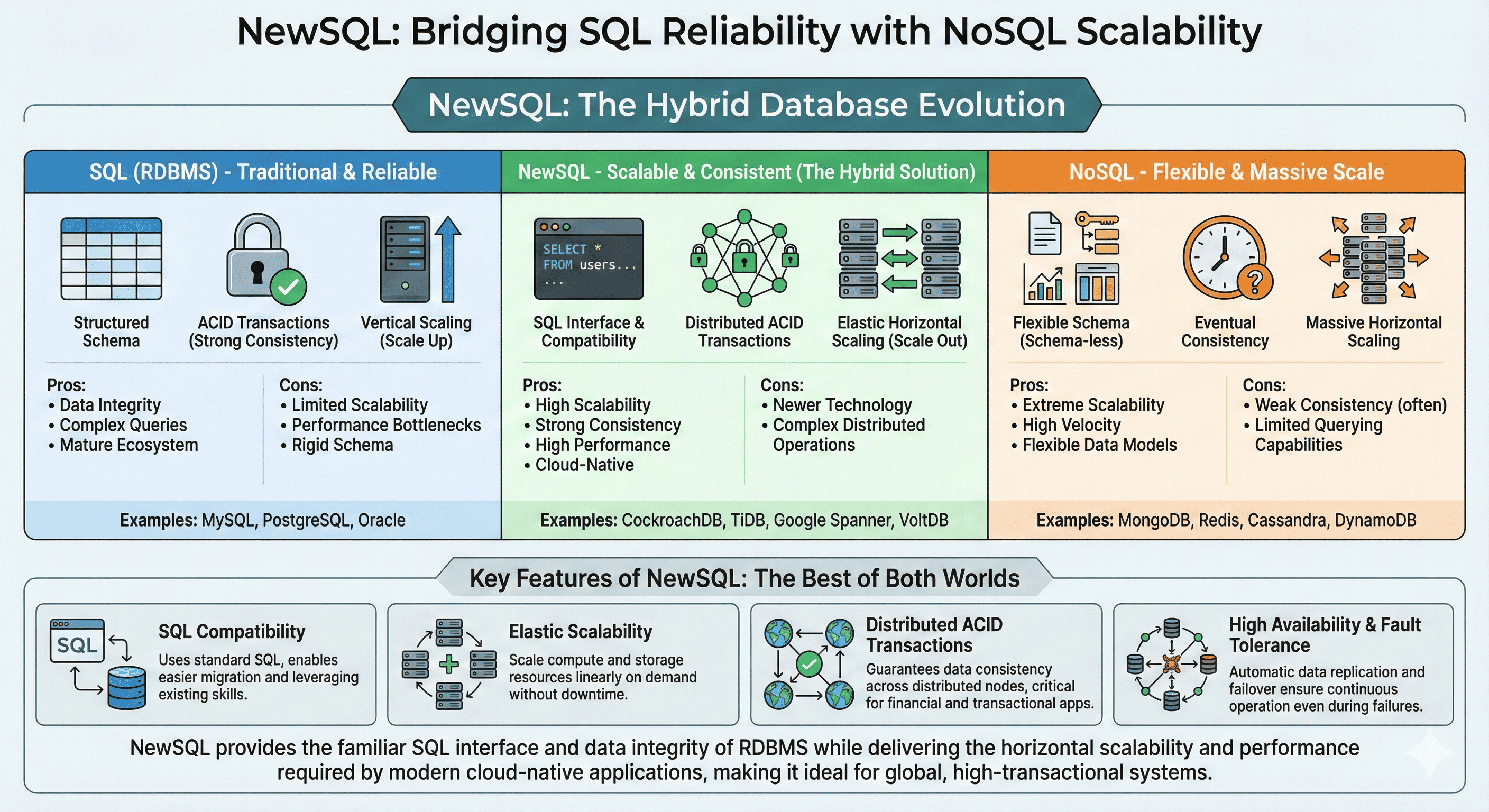
Enter NewSQL—a solution designed to overcome these limitations. NewSQL is a next-generation database system that maintains the traditional relational model while providing the horizontal scalability and high-performance processing capabilities of NoSQL.
Related Articles
Understanding NewSQL requires context from related database concepts:
- Redis (Remote Dictionary Server) Overview
- Database Schema Concepts
- MongoDB Introduction
- Database Operators in Kubernetes (DOIK) Week 1
- Deploying Cassandra with StatefulSet
- Data Automation with GCP
- PostgreSQL Concepts and Features
- Database Sharding: Concepts and Mechanisms
- Database Integrity and Constraints
- Large-Scale Data Processing and Architecture Design
What is NewSQL?
NewSQL is represented by systems like Google Spanner, CockroachDB, and TiDB, and features the following characteristics:
| Feature | Description |
|---|---|
| ✅ Maintains Relational Model | Uses SQL syntax, normalized table structures |
| ✅ Supports Horizontal Scaling | Performance scaling through cluster-based node addition |
| ✅ ACID Guarantees | Transaction consistency and atomicity even in distributed environments |
| ✅ High-Performance Processing | Utilizes modern technologies like memory-based processing, async I/O, MVCC |
| ✅ Cloud-Optimized | Automatic failover, multi-region synchronization, scale-out architecture |
Differences from Existing DBMS
| Category | RDBMS (e.g., MySQL, PostgreSQL) |
NoSQL (e.g., MongoDB, Redis) |
NewSQL (e.g., CockroachDB, TiDB) |
|---|---|---|---|
| Structure | Fixed schema | Flexible schema | Fixed schema |
| Language | SQL | Non-SQL, various query languages | SQL |
| Transactions | ACID support | Not guaranteed or weak | Full ACID support (including distributed) |
| Scalability | Vertical scaling | Excellent horizontal scaling | Horizontal scaling + ACID |
| Use Cases | Finance, ERP, traditional apps | SNS, log storage, caching | Fintech, SaaS, global services |
Major NewSQL Database Systems
Leading NewSQL Platforms
| DBMS | Key Features |
|---|---|
| Google Spanner | Global transaction support, TrueTime-based precise synchronization |
| CockroachDB | PostgreSQL compatible, automatic replication and recovery |
| TiDB | HTAP support, simultaneous OLAP + OLTP processing |
| VoltDB | In-memory based, strong in real-time analytics |
| MemSQL (SingleStore) | High-speed processing + parallel query optimization |
Deep Dive: Google Spanner
Google Spanner revolutionized distributed databases:
Key Innovations:
- TrueTime API: Uses atomic clocks and GPS for global synchronization
- External Consistency: Strongest consistency guarantee for distributed transactions
- Scalability: Handles petabytes of data across continents
- SQL Interface: Full SQL support with joins and secondary indexes
Deep Dive: CockroachDB
Open-source NewSQL with PostgreSQL compatibility:
Architecture Highlights:
- Raft Consensus: Ensures data consistency across replicas
- Geo-Partitioning: Data residency compliance for GDPR, etc.
- Survivability: Automatic recovery from node failures
- Zero-Downtime Migrations: Rolling upgrades without service interruption
Deep Dive: TiDB
Hybrid transactional and analytical processing:
Unique Features:
- TiFlash: Columnar storage for analytical queries
- TiKV: Distributed key-value store for transactions
- MySQL Compatibility: Easy migration from MySQL
- HTAP: Run analytics without ETL pipelines
When Should You Use NewSQL?
NewSQL is particularly advantageous in these scenarios:
Ideal Use Cases
- Global Cloud-Based Services Requiring Horizontal Scaling
- Multi-region deployments
- Unpredictable growth patterns
- Geographic data distribution requirements
- Platforms Requiring Real-Time Analytics and Transactions Simultaneously
- Gaming platforms (player stats + leaderboards)
- Ad tech (bidding + reporting)
- Fintech (transactions + fraud detection)
- When Experiencing RDBMS Scaling Limitations
- Single-server bottlenecks
- Vertical scaling costs becoming prohibitive
- Need for 24/7 availability without downtime
- When NoSQL’s Eventual Consistency Poses Business Risks
- Financial transactions requiring immediate consistency
- Inventory management
- Booking systems (seats, tickets, reservations)
NewSQL Limitations and Real-World Considerations
While NewSQL is undoubtedly attractive, there are practical constraints to consider before adoption:
Challenges to Consider
| Challenge | Description |
|---|---|
| Implementation Complexity | Initial setup can be complex due to distributed system nature (configuration, monitoring, cluster composition) |
| Limited Operational Experience | Relatively less operational experience and community resources compared to RDBMS/NoSQL |
| Query Performance Tuning | Even using SQL, internal architecture differs from RDBMS, requiring different tuning approaches |
| Migration Costs | Data transfer from existing RDBMS requires careful consideration of schema design and synchronization issues |
Learning Curve
-- Looks like standard SQL...
CREATE TABLE users (
    id UUID PRIMARY KEY DEFAULT gen_random_uuid(),
    email STRING UNIQUE,
    created_at TIMESTAMP DEFAULT now()
);

-- But distribution is happening behind the scenes
ALTER TABLE users SPLIT AT VALUES
    ('00000000-0000-0000-0000-000000000000'),
    ('80000000-0000-0000-0000-000000000000');
Common Misconceptions About NewSQL
Misconception 1: “NewSQL = Simply Faster RDBMS”
Reality: NewSQL involves complex mechanisms like distributed transactions, replication, and synchronization.
Traditional RDBMS:
App → Single Server → Disk

NewSQL:
App → Load Balancer → [Node 1, Node 2, Node 3] → Distributed Storage
                        ↓ Raft Consensus
                        ↓ Multi-Paxos
                        ↓ 2PC/3PC
Misconception 2: “ACID = Slow”
Reality: This paradigm is shattered in NewSQL. Google Spanner processes transactions in milliseconds even in globally distributed environments.
Performance Metrics:
- Google Spanner: 99.999% availability, <10ms latency
- CockroachDB: 1M+ reads/sec on commodity hardware
- TiDB: Sub-second analytical queries on transactional data
Misconception 3: “PostgreSQL Compatible = Just PostgreSQL?”
Reality: For example, CockroachDB only has a similar SQL interface; internally it’s a complete distributed processing engine.
Differences:
-- PostgreSQL: Single-node transaction
BEGIN;
UPDATE accounts SET balance = balance - 100 WHERE id = 1;
UPDATE accounts SET balance = balance + 100 WHERE id = 2;
COMMIT;

-- CockroachDB: Distributed transaction across nodes
BEGIN;
-- May involve nodes in different data centers
UPDATE accounts SET balance = balance - 100 WHERE id = 1; -- Node in US
UPDATE accounts SET balance = balance + 100 WHERE id = 2; -- Node in EU
COMMIT; -- Distributed consensus achieved
Implementation Checklist for Production
Pre-Implementation Assessment
| Item | Checkpoints |
|---|---|
| Traffic Pattern | Read vs Write ratio, TPS metrics |
| Scaling Requirements | Global expansion needs, clustering requirements |
| Consistency Level | Strong consistency required? Eventual consistency sufficient? |
| Budget & Infrastructure | DB operations team, cloud usage plans |
| Data Structure | Normalized relational structure? Flexible modeling needed? |
Technical Evaluation
Architecture Patterns
Pattern 1: Multi-Region Deployment
# CockroachDB Multi-Region Configuration
apiVersion: crdb.cockroachlabs.com/v1alpha1
kind: CrdbCluster
metadata:
  name: global-cluster
spec:
  regions:
    - name: us-west
      nodeCount: 3
      zones:
        - us-west-1a
        - us-west-1b
        - us-west-1c
    - name: eu-central
      nodeCount: 3
      zones:
        - eu-central-1a
        - eu-central-1b
        - eu-central-1c
    - name: asia-east
      nodeCount: 3
      zones:
        - asia-east-1a
        - asia-east-1b
        - asia-east-1c
Pattern 2: HTAP Workload Separation
-- TiDB: Separate OLTP and OLAP workloads

-- OLTP: Real-time transactions (TiKV)
INSERT INTO orders (user_id, amount) VALUES (123, 99.99);

-- OLAP: Analytics (TiFlash)
SELECT
    DATE_TRUNC('day', created_at) as day,
    SUM(amount) as total_revenue
FROM orders
WHERE created_at >= NOW() - INTERVAL '30 days'
GROUP BY day;
-- Automatically uses TiFlash columnar storage
Pattern 3: Geo-Partitioned Data
Migration Strategies
Strategy 1: Dual-Write Migration
# Gradual migration with dual writes
class DatabaseRouter:
    def write(self, data):
        # Write to both old and new DB
        old_db.write(data)
        try:
            new_db.write(data)
        except Exception as e:
            log_migration_error(e)

    def read(self, query):
        # Read from old DB initially
        if migration_percentage > random():
            return new_db.read(query)
        return old_db.read(query)
Strategy 2: Change Data Capture (CDC)
Strategy 3: Blue-Green Deployment
# 1. Set up parallel NewSQL cluster
kubectl apply -f newsql-cluster.yaml

# 2. Replicate data
pg_dump source_db | cockroach sql --url "postgresql://..."

# 3. Switch traffic
kubectl patch service db-service -p '{"spec":{"selector":{"app":"newsql"}}}'

# 4. Validate and rollback if needed
Performance Optimization
Optimization 1: Index Strategy
-- Secondary indexes in distributed environment
CREATE INDEX idx_user_email ON users (email)
STORING (name, created_at);  -- Covering index to avoid lookups

-- Partitioned indexes for geo-distribution
CREATE INDEX idx_orders_region ON orders (region, created_at)
PARTITION BY LIST (region) (
    PARTITION us VALUES IN ('us-west', 'us-east'),
    PARTITION eu VALUES IN ('eu-central', 'eu-west'),
    PARTITION asia VALUES IN ('asia-east', 'asia-south')
);
Optimization 2: Connection Pooling
# Efficient connection management
from sqlalchemy import create_engine, pool

engine = create_engine(
    "postgresql://user:pass@cockroachdb-cluster:26257/db",
    poolclass=pool.QueuePool,
    pool_size=20,          # Max connections
    max_overflow=10,       # Burst capacity
    pool_timeout=30,       # Wait time for connection
    pool_recycle=3600      # Recycle connections hourly
)
Optimization 3: Query Patterns
-- Avoid distributed joins when possible
-- Bad: Join across regions
SELECT * FROM us_users u
JOIN eu_orders o ON u.id = o.user_id;

-- Good: Co-locate related data
CREATE TABLE orders (
    order_id UUID PRIMARY KEY,
    user_id UUID,
    region STRING,
    FOREIGN KEY (user_id) REFERENCES users(id)
) PARTITION BY LIST (region);
Monitoring and Observability
Key Metrics to Monitor
# Prometheus metrics for CockroachDB
- metric: sql_exec_latency
  description: SQL execution latency
  threshold: p99 < 100ms

- metric: replicas_leaders_not_leaseholders
  description: Leadership misalignment
  threshold: < 5%

- metric: storage_live_bytes
  description: Live data size
  alert_on: growth_rate > 20%/day

- metric: clock_offset_meannanos
  description: Clock synchronization
  threshold: < 500ms
Distributed Tracing
# OpenTelemetry integration
from opentelemetry import trace
from opentelemetry.instrumentation.sqlalchemy import SQLAlchemyInstrumentor

tracer = trace.get_tracer(__name__)

with tracer.start_as_current_span("database_query"):
    result = session.execute(
        "SELECT * FROM orders WHERE user_id = ?",
        (user_id,)
    )
Cost Considerations
TCO Analysis
| Component | Traditional RDBMS | NewSQL |
|---|---|---|
| Hardware | High-end single server | Commodity hardware cluster |
| Licensing | Per-core or per-socket | Open-source or cloud-based |
| Operations | Vertical scaling events | Automated horizontal scaling |
| Downtime | Scheduled maintenance | Zero-downtime upgrades |
| Disaster Recovery | Complex replication setup | Built-in multi-region |
Cost Optimization Tips
# Right-size your cluster
cockroach node status --host=cluster-url
# Monitor CPU/memory usage
# Scale nodes based on actual load

# Use spot instances for non-critical replicas
kubectl label nodes spot-node-1 workload=replica
kubectl taint nodes spot-node-1 spot=true:NoSchedule

# Implement data retention policies
DELETE FROM logs WHERE created_at < NOW() - INTERVAL '90 days';
Real-World Case Studies
Case Study 1: Global E-Commerce Platform
Challenge: MySQL replication lag causing inventory inconsistencies
Solution: Migrated to CockroachDB
- Result: Zero replication lag, 99.99% availability
- Performance: 10x improvement in write throughput
- Cost: 40% reduction in infrastructure costs
Case Study 2: Fintech Application
Challenge: Need for strong consistency in distributed environment
Solution: Implemented Google Spanner
- Result: External consistency for all transactions
- Compliance: Met regulatory requirements for audit trails
- Scalability: Seamlessly handled 100x traffic growth
Case Study 3: Gaming Platform
Challenge: Real-time leaderboards with global players
Solution: Adopted TiDB for HTAP workload
- Result: Real-time analytics without ETL
- Performance: Sub-second query response times
- Developer Experience: Maintained familiar MySQL syntax
Future of NewSQL
Emerging Trends
- Serverless NewSQL: Pay-per-query pricing models
- AI-Optimized: Automatic query optimization using ML
- Edge Computing: NewSQL at the edge for IoT
- Quantum-Ready: Preparing for post-quantum cryptography
Technology Evolution
2020: NewSQL emerges as viable alternative
2022: Cloud providers adopt NewSQL natively
2024: NewSQL becomes mainstream for new projects
2026: Hybrid RDBMS+NewSQL architectures common
2028+: NewSQL as default for distributed systems
Conclusion
NewSQL is a hybrid DBMS that combines the advantages of relational databases with the scalability of NoSQL. It maintains a familiar SQL-based interface while providing performance and stability suitable for modern large-scale distributed architectures.
Key Takeaways
NewSQL is not simply “fast SQL”. It’s an evolutionary database that simultaneously achieves the stability of relational data + the scalability of NoSQL.
Already in Active Use:
- Startups experiencing performance limitations with PostgreSQL or MySQL
- Large enterprises operating global services
- Fintech platforms requiring both real-time transactions and analytics
Important Considerations
However, operational complexity and migration risks still exist, so it’s crucial to carefully analyze use cases, operational capabilities, and data characteristics before adoption.
The Future of Database Selection
Database selection going forward is not simply SQL vs NoSQL, but rather “multi-stack strategies including NewSQL” that will become mainstream.
While some are still in early adoption stages or lack extensive learning resources, systems like Google Spanner, CockroachDB, and TiDB are growing rapidly and are likely to establish themselves as the mainstream of cloud-native databases.
If you’re feeling the limitations of traditional databases, now is the time to seriously consider NewSQL adoption.
Decision Framework
┌─────────────────────────────────────────┐
│    Do you need ACID guarantees?        │
│              ↓ Yes                       │
│    Do you need horizontal scaling?      │
│              ↓ Yes                       │
│    Is SQL familiarity important?        │
│              ↓ Yes                       │
│          → NewSQL is ideal              │
└─────────────────────────────────────────┘
References
- CockroachDB Official Documentation
- TiDB Docs (PingCAP)
- Google Cloud Spanner
- VoltDB Architecture Guide
- SingleStore (formerly MemSQL)
- NewSQL Trends - DB Engines Ranking
- Designing Data-Intensive Applications - Martin Kleppmann (Book Recommendation)
- The End of Traditional Databases? NewSQL Explored – ThoughtWorks Radar (Book Recommendation)
- SQL vs NoSQL vs NewSQL
- NewSQL Database Systems for Distributed Applications

Comments